
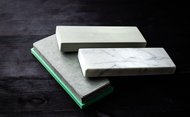
Important Notes on the Use of Your Pocket Knife Sharpener
10th Dec 2025
It might seem straightforward how to properly use a pocket knife sharpener to get your EDC knife sharp again, but while it isn’t rocket science, there are still a few things you need to know how to do - as well as what not to do - to be successful. Let this short post serve as a jumping off point.
One Stone May Not Be Enough
If your knife is very dull, a fine stone or a finishing stone will not be enough to restore your edge. You will need a coarser grit stone for that, but the catch is that a coarse grit stone alone will not be sufficient to make your knife razor sharp.
Rather, you will need a series of stones, generally ranging from approximately 200 to 1000 grit, to sharpen your knives effectively, and depend on the condition of their edges.
Sharpening Angle Is Critical
This is perhaps the most important piece of information in this whole post. The angle at which you sharpen your knives is critical to the finished edge. A razor can be utterly ruined by an oblique edge; similarly, sharpening an ax or a cleaver with an edge that’s too fine will cause it to dull more quickly at best; at worst, you can chip or roll the edge.
For most applications, an angle of around 15 to 17 degrees is ideal, but if in doubt, match the angle that already exists on your edge.
Water Is Not Absolutely Necessary
There are some schools of thought that you need to saturate the surface of a sharpening stone with water. The argument is that water prevents the pores of the stone from getting clogged with steel dust and swarf as you sharpen, floating away these particles and maintaining the cutting efficiency of the stone.
There is absolutely some truth to this, and many people soak their pocket knife sharpeners before using them, but here’s the truth. You don’t have to use water, and the sharpening angle you employ, as well as the grit of the stone, are both significantly more important than whether or not you wet the surface of the stone before you use it.
Once You Use Oil, You Can Only Use Oil
Now, it is important to note that some people use oil on their sharpening stones instead of water, for the same supposed reasons that people wet their stones. The oil is supposed to float away the particles and keep the stone efficient.
The thing about using water for this, however, is that water evaporates, and once the stone is dry, it’s back to the way it was. If you apply oil to your stone, you will never be able to get it out.
So, just be sure that you want to use oil before you apply it to your stone, because once you do, you will only ever be able to use oil again.
You Will Eventually Need a Flattening Stone
If you own your pocket knife sharpening stone for long enough, the surface will wear down and become bowed in the middle. As you might imagine, a bowed sharpening stone will not effectively sharpen a knife, and the surface will need to be restored.
To do so, you will need what is known as a flattening stone, which is run over the surface of the sharpening stone to level it again.
Inwardly Curved and Recurved Blades Cannot Be Sharpened on a Flat Stone
Many pocket knives, notably those with recurved blades or talon blades, also known as hawkbill blades or karambits, cannot be sharpened on a flat pocket knife sharpener. They will need a special type of sharpener.
This is because it is impossible to contact the edge of the blade at an appropriate angle to sharpen it. For these knives, you will need a sharpening rod, which will either be a diamond rod or a ceramic rod, to sharpen the edge.
You Will Need a Strop, Not Just a Stone, to Get Your Knife Really Sharp
Lastly, if you want to get a truly razor sharp edge on any of your knives, you will not be able to do so on a stone alone.
You will also need something called a strop, which is usually a strip of leather but which may also be made of a paddle.
To use a strop, you run the knife spine first away from the strop, with the flat of the blade against it. This aligns all the microserrations on the edge that were left from sharpening, making the knife truly as sharp as possible.
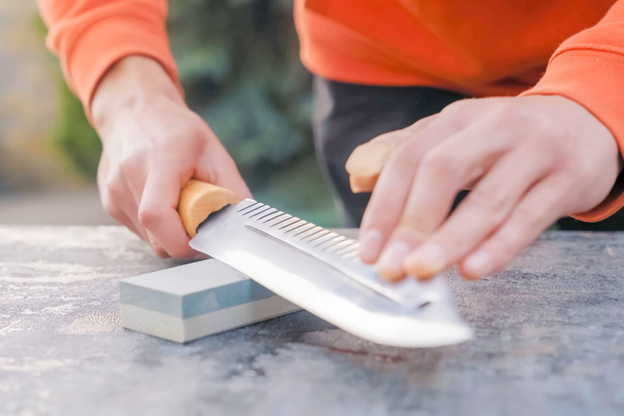
Shop Pocket Knife Sharpeners and Sharpening Systems Here
In the market for a new pocket knife sharpener, a sharpening system, or just a new bench sharpening stone to bring your full knife back to life? We have what you need - shop our full collection and get in touch with us at WhiteMountainKnives@gmail.com if you have any questions.