
Step by Step Folding Pocket Knife Care
26th Nov 2025
All knives require care and maintenance, but a folding pocket knife, all else being equal, will require a bit more than a fixed blade, simply by virtue of the fact that it has moving parts.
That being the case, here are some high level notes for how to take care of your folding pocket knife.
- Rinse and dry the knife. The first step in basic folding pocket knife maintenance is fairly straightforward. Simply rinse the knife to wash away and lint, salt deposits or any other dirt that might be on the surface or between the liners or scales, then allow the knife to dry before you proceed.
- Use compressed air to clean out the space between the liners. Once the knife is dry, use a can of compressed air to blast away any lint or dust that’s between the liners. Folding pocket knives tend to accumulate lint here, and it can also accumulate around the pivot point. It might look harmless, but if that lint gets in the bearing it will make the knife operate all gritty. Also, lint can be surprisingly abrasive. A can of compressed air should suffice to blast all of this stuff out.
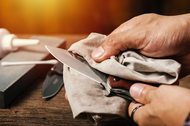
- Wipe off any visible debris. Once you’ve removed any lint and dust that you could with compressed air, get a clean microfiber rag and use that to wipe off the blade and scales, as well as between the liners, if you can. Pay close attention to the shoulder of the knife where it comes in contact with the pivot. This area will accumulate grease and dirt and is one of the hardest areas to clean on a folding pocket knife, without completely disassembling it.
- Use a nylon brush to scrub off any loose deposits. If there’s anything left on the knife that you can’t reach with a microfiber cloth, get a nylon cleaning brush and use that to remove any deposits that remain on the knife. The brush will prove more effective than a rag at reaching in between the scales as well as at cleaning the pivot and the area around the base of the knife, as it offers more precision than a cloth.
- Get out a cleaning pick to remove any other stubborn debris. If there’s anything left that you can’t reach with the nylon cleaning brush or the microfiber rag, use a cleaning pick to dislodge it, then wipe it away. By this post, you should have a mostly clean knife, free of all surface debris and residue.
- Tighten all screws and other fasteners. Over time, carrying and using a knife, or just letting it ride in your pocket, can let some of the hardware work free. This includes not just the screws that hold the knife together, but the hardware that secures the pivot mechanism, as well as the hardware that secure the pocket clip, if there is one. Most of these little fasteners will take either a small philipshead or hex driver, and in some cases they might require a Torx bit. Give the knife a once-over, checking each screw and tightening as needed. The last thing you want is to take out your folding pocket knife only to discover that some of the screws are missing.
- Oil the pivot and hardware, then wipe down. Lastly, you will want to treat the knife with a bit of oil, both to lubricate it and to protect it against corrosion. Gun oils like Rem Oil and Hoppe’s will work just fine; if you are concerned about food-safe oil, and use the knife for food prep, Tsubaki oil will work even better. Lightly oil the pivot, then oil the blade and wipe off any excess. Then apply just a bit to the top of each fastener in order to protect it from corrosion and prevent seizure. After you’re done, wipe away any visible oil that remains on the surface. As effective as oil is at lubricating and preventing corrosion, too much of it will actually attract dirt.
Other High Level Notes
While the information already covered here is more than adequate for general cleaning and maintenance of a folding pocket knife without the need to fully disassemble it, here are a few high-level notes.
- Never put the knife away dirty or wet. Regardless of whether or not your knife sports a stainless or a non-stainless blade, you never want to put it away wet. Doing so is a recipe for rust and seizure. Whether or not you are going to actively clean it, anytime you get your knife wet, you should wipe it down and let it thoroughly air dry before you put it away.
- Be careful about using a folding pocket knife with a non-stainless blade in a saltwater environment. Many folding pocket knives are made with blades of stainless steel alloys. Many are not. Be judicious about how and where you use your pocket knife. If the blade is made of a steel in the 10XX class, or a tool steel like D2, you should be very shy about using it around any marine environment. Saltwater is a dangerously corrosive agent and many non-stainless alloys are not forgiving. Even if you diligently clean them off after use, residual salt deposits can cause staining, rust, and even stress corrosion cracking. It’s best to relegate any non-stainless folding knife to use away from marine exposure.
Here for a New Folding Pocket Knife?
In the market for a new folding pocket knife to round out your collection? Take a look at what’s in stock here at White Mountain Knives and freshen up your pocket dump today. We represent the best brands in the business with plenty of new entries in addition to the industry classic staples. Get familiar with what we offer and get in touch with us at WhiteMountainKnives@gmail.com if you are looking for some carry knives, or anything else that you don’t see listed.